From Handbills to Hashtags: Promotion Finds New Publics
See how promotion moves from handbills to hashtags, and learn how each distribution method shapes who can encounter a message and pass it on.
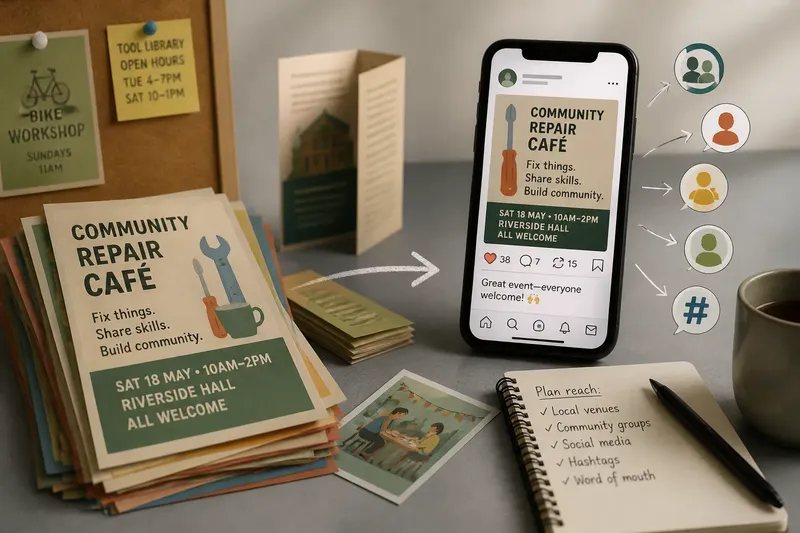
A handbill tucked beneath a café door reaches whoever walks through that doorway; a hashtagged post can turn up on the phone of someone across town. The shift from handbills to hashtags is not simply a change of format. It changes who might encounter a message, where they meet it and whether they can carry it further.
These seven changes help explain why a campaign’s distribution is part of its meaning, not just the route it takes to an audience.
1. A handbill begins with a place
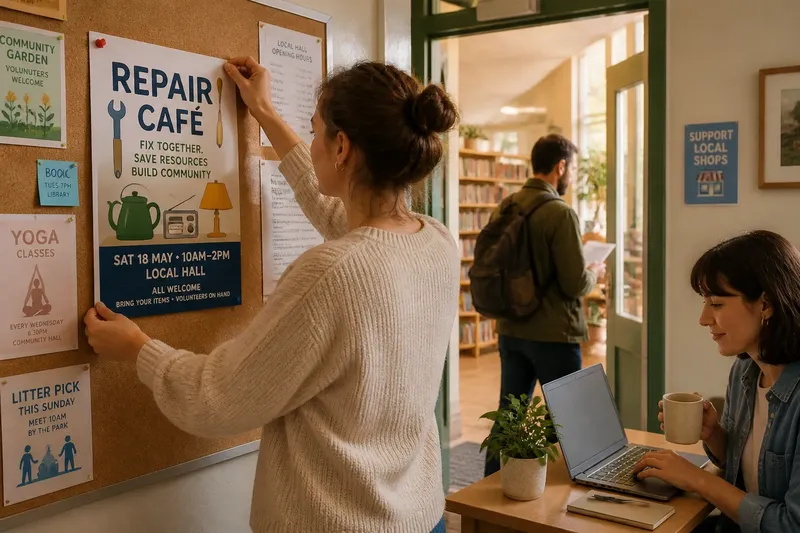
Printed promotion has a physical address, even when it has no named recipient. A flyer on a library noticeboard, a leaflet handed out near a station and a card left on a community hall table each meet people in a particular setting. The setting narrows the likely audience, but it also offers a clue about why the message is there.
That local context can do quiet work. A notice about a neighbourhood repair café feels relevant beside a tool library; the same paper left far from the venue may seem random. Distribution is therefore a choice about proximity: which streets, shops, queues or shared spaces bring the intended readers close enough to notice?
Physical placement also makes access uneven. A person has to pass the display, be able to read it and have a moment to stop. Someone who does not visit that place may never see the message, however clear or attractive the design.
2. Reproduction loosens the link to one venue
When a message can be copied easily, its reach no longer depends on the original stack of paper. A handbill may be photographed and sent in a group chat; a poster can be scanned, reprinted or shared as an image. The information begins to travel beyond the place where it was first displayed.
But copying does not automatically create a public. A digital image passed between two neighbours still travels through their existing relationship. A paper copy posted in another building reaches a different cluster, yet remains dependent on someone deciding to put it there.
Imagine a local theatre printing a handbill for a reading at its entrance. A volunteer photographs it and shares the image in a residents’ group; the expected observable result is that some group members can see the details without visiting the theatre, while people outside the group may still miss them. The route has expanded, but not become universal.
3. Networked posts make sharing part of distribution
A networked post can travel through personal feeds, group pages, direct messages and public tags. Each share can place the same message in front of a new set of people, with the sender’s own caption acting as a small introduction. Unlike a handbill, the post can move without its creator physically placing another copy.
This gives audiences a more active role in circulation. A recipient may forward the post to a friend who would not follow the original organisation, adding a new connection to the route. Yet sharing is a choice, not a built-in outcome: people may scroll past, keep the information private or decide it is not relevant to their contacts.
The useful question for a campaign is not simply whether a post is shareable. Ask who is likely to share it, with whom, and what context will travel alongside it. A message that depends on a caption for essential details may lose clarity when that caption is stripped away.
4. Hashtags create a route across separate networks
A hashtag can gather posts from accounts that do not follow one another. Someone looking for a local festival, a public discussion or a particular community topic may find a tagged post through a search or a topic feed. The tag offers a route based on interest rather than a pre-existing personal connection.
That route is only as useful as the tag’s meaning and the audience’s habits. A broad tag can place a message among unrelated posts; a very specific one may be difficult for a newcomer to guess. Local groups may use familiar shorthand that outsiders do not recognise, while a widely used term can carry several meanings at once.
Choosing a tag is thus a decision about discoverability and interpretation. A campaign can pair a precise community term with a plain-language description in the post itself, so readers do not need to decode the tag before understanding the invitation.
5. Search and feeds favour different kinds of encounter
A person who searches for a named event is already looking for information. A person who sees its promotion in a feed may not have been looking for anything at all. These are different moments of encounter: one begins with a question, the other with interruption.
Printed handbills commonly rely on being present where a likely reader will pass. Online distribution can add search results and recommendation feeds, which may surface a message well beyond the organisation’s direct followers. The campaign gains another route, but its appearance depends on platform systems and a user’s choices, so visibility is not assured.
That difference affects what a post needs to carry. A searcher may recognise the event name and want a venue or date; a passing feed reader may first need to understand what the event is and why it could matter to them. The same campaign can therefore require a clear, self-contained post as well as a discoverable title or tag.
6. Wider circulation can lose local context
As a message travels, it can reach people who do not share the assumptions of its first audience. A handbill on a community noticeboard sits among nearby services and familiar names. A repost elsewhere may arrive without that background, making a local abbreviation, venue nickname or unexplained reference harder to follow.
Circulation can also detach a post from the original account. A screenshot may omit the date of an update, the organiser’s identity or a link to fuller information. Good distribution planning anticipates this: essential details should remain understandable when the message is seen out of sequence or separated from its source.
This is not a reason to avoid sharing. It is a reason to make the message portable. Use a recognisable organiser name, spell out the place clearly and include enough context for a reader encountering the post through someone else’s share.
7. Reach depends on who can access each route
No channel reaches everyone. A paper notice may be available to someone who rarely uses social media, while an online post can be easier for a person who cannot travel to the venue where handbills are distributed. Each route has its own barriers: location, timing, language, device access, account settings and the effort required to find the information.
For a community campaign, combining routes can make sense when the audiences and circumstances differ. A printed notice in a library, a post from the organiser’s account and a message circulated by a partner group may each reach people the others miss. The point is not to duplicate the same distribution everywhere, but to choose places and networks that connect with different parts of the intended public.
Small adjustments can help: use readable type on printed material, write social posts in direct language and provide a route to fuller details. Where a campaign relies on a particular venue, platform or community group, consider who is absent from that space and whether another route is appropriate.
What changes when promotion moves online?
Does a hashtag make a post visible to everyone?
No. It can help people discover a post through a topic, but readers still need to use that tag or encounter the post through another route. Platform settings and individual choices also shape what appears.
Are handbills still useful for local promotion?
They can be useful where people share physical spaces, such as libraries, cafés or community venues. Their reach depends on placement and on whether likely readers visit those places.
Why can a shared post confuse new readers?
It may arrive without the original caption or the background its first audience already knew. Include the organiser, the purpose and the essential event details in the material that is likely to be copied.
How should a campaign choose between print and social posts?
Start with where the intended audience is likely to encounter information and what access barriers matter. If different groups use different spaces, a considered mix of routes may be more useful than choosing one format for everyone.
From handbills to hashtags, distribution shapes the public a message can reach—and the context in which that public receives it. Before choosing a format, trace the likely route: where the message appears, who can pass it on and what a newcomer will understand when it arrives. That simple habit makes the choice of channel a choice about people, not just media.